University of Houston Athletics
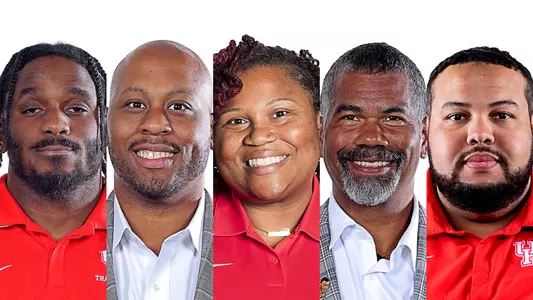
Black Athletics Staffers Impacting Athletes Beyond the Playing Surface
2/17/2026 10:00:00 AM | General
During Black History Month, Houston Athletics highlights Black support staffers, coaches and administrators and the work they do in the department
Black History Month isn't just about honoring Houston Athletics historic past and reputation for breaking barriers. This month, Houston Athletics will spotlight current employees, coaches and administrators that continue to lead the department when it comes to exposure, carrying responsibility, redefining opportunity and impacting student-athletes daily.
Houston Cougar student-athletes compete and train every day to ensure the brand continues to grow. What goes on behind the scenes helps those student-athletes compete at their best, from how they train, to how they learn, to the resources that help fund their programs and scholarships, to their mental health and to being equipped with the best gear and technology. But for Houston's Black athletics employees, representation and resilience demonstrate that there is a life after college athletics and that there is someone who has a similar story as them that they can connect with.
For Assistant Athletics Director of Equipment Andrew Johnson, Coordinator of Sports Performance Jamal Jones, Assistant Director for Academic Services Marissa Jones, and Director of Mental Health Services Dr. Emmett Gill, representation is important because they interact with student-athletes of all cultures and backgrounds and appreciate that Black student-athletes have someone that may have first-hand experiences that resonate with them.
The trust is important because the majority of a student-athlete's day is spent at their respective athletics facility. Memorial Hermann Football Operations Center. Guy V. Lewis Development Center. Baseball Development Center. Athletics Alumni Center. When these student-athletes are spending time around these support staffers every day, they begin to connect with the support staffers that share life experiences and support their well-being and life goals.
 |
| Marissa Jones, Assistant Director of Academics Services |
"We talk about so much more than academics," Marissa Jones said. "This is a safe place where they can tell us their highs and their lows, gripes about circumstances going on in their lives, boyfriends, girlfriends, whatever it be."
We know the statistics about how many college athletes go pro – less than 2% in football, less than 1% in women's soccer, 5% in baseball, 1% in basketball. Talking about life after college happens in every corner of the Athletics Alumni Center.
"I don't think people outside of athletics know how much life advice is talked about when we train," Jamal Jones said. We have conversations daily about life after college.
Sometimes it takes a while to see the fruit of the conversations, hours spent together relationship building.
 |
| Jamal Jones, Sports Performance Coordinator |
These conversations, specifically with Black student-athletes are built on the trust and the representation that they see in Black support staff roles like Marissa, Jamal and Dr. Gill's.
"It's essential that Black student-athletes see employees that look like them," Dr. Gill said. "It gives Black student-athletes someone they can relate to and an example of someone who made it in the athletics industry and they can too."
Representation has been a building block of the Houston Athletics Department for decades. Warren McVea. Flo Hyman. Elvin Hayes. Don Chaney. They paved the way in Texas and across the South as some of the first, if not the first, Black student-athletes in their respective sports to either suit up for a major Division I program or to earn a scholarship.
What many may not know, is that Houston Athletics is also the only Big 12 school to have a Black Chief Revenue Officer – Alvin Franklin – and one of a handful of Power 4 schools with a Black assistant athletics director for equipment manager – Andrew Johnson.
For Both Franklin and Johnson, they see representation as a responsibility. A responsibility to leave their jobs better than when they started, their departments better than they inherited and their industries better than they when they began in their field.
 |
| Alvin Franklin, Chief Revenue Officer |
Franklin has worked the majority of his career in the South, but when he was at Purdue, he made a point to wear a full suit and tie on Mondays. What his coworkers in Indiana didn't know was why Franklin did that. "They asked me why I wore a suit," Franklin said. "I told them, 'I wear this to represent those from my community in Jackson, Miss., that didn't have the opportunity to do anything outside of sports.' There were tears in that Monday meeting."
Franklin doesn't wear a suit on Mondays anymore, but he has paved a way, along with Johnson, that shows student-athletes every day that the only way out isn't always through being an athlete. For many young Black athletes, the path out from their circumstances is often believed to be through success in sport or risk being left behind. Johnson and Franklin try and show an alternative – working in athletics.
"I grew up thinking that the only way to 'get out' was to be an athlete," Johnson said. "But now I get to show our [football team] that there is another way – working in athletics."
 |
| Andrew Johnson, Assistant AD for Equipment Services |
"I went to a predominantly white high school but played AAU and ran club track with predominantly black teammates and only black coaches," Jamal Jones said. "Having that experience, plus learning from my mentor Todd Smith at Marquette, helped me connect, communicate, motivate and hold athletes accountable from any walk of life."
No matter which athletes Marissa Jones is working with, she tries to instill her positive attitude onto everyone. She always tells her athletes, who come from all over the globe, you can't change the situation, but you can change your attitude about it.
Inside the Houston Athletics department, Black history is on display every day and the role models of today are shaping the role models of tomorrow through a litany of ways.
"When Black athletes look back on their time here, we hope they say we were instrumental to their success," Dr. Gill said.
 |
| Dr. Emmett Gill, Director of Mental Health Services |
A student-athlete opening up because an advisor, mental health expert or coach or manager understands their background.
A future young professional realizing athletics careers extend beyond their playing careers.
A staff room that reflects not just diversity of color, but diversity of thought.
A mentor preaching positivity despite the situation.
For some, being Black has had its speed bumps, for others, they have not necessarily experienced straight-up racism. But racism still exists today. Houston employees are hoping to show the next generation of athletes, athletics employees, and community leaders how to make the future better than the past.